The Japanese te-form (て形): how to make it and what it does
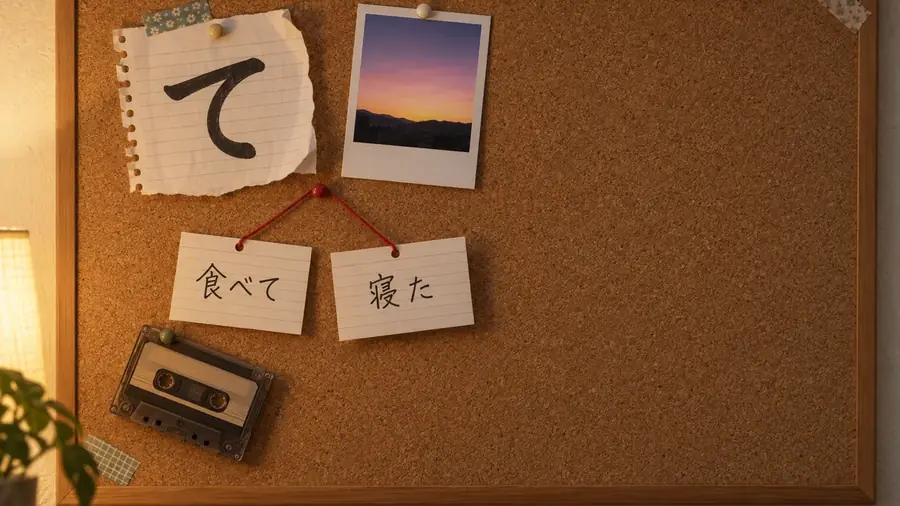
The te-form is the verb form ending in て or で that links one action to the next. 食べて寝た (tabete neta) means “I ate and then slept,” and only 寝た carries the past tense. To make the te-form, you change the last kana of the dictionary form. There are five changes and one exception. You can hear and try them all below.
What the te-form is used for, at a glance
Eight jobs, one line each. Tap one to jump to the examples with audio.
- 〜て、〜link actions in order
- 〜ているhappening now, or a state
- 〜てくださいplease do
- 〜てもいいですかmay I?
- 〜てからafter doing A, B
- 〜てしまうdone, or regrettably done
- 〜てはいけませんnot allowed
- 〜てみるtry doing
How to make the te-form
Japanese verbs come in three kinds: u-verbs (godan), ru-verbs (ichidan), and two irregulars. Ru-verbs and the irregulars are easy. U-verbs change by the last kana of the dictionary form, and there are only five outcomes to learn.
| Ends in | Becomes | Examples |
|---|---|---|
| う ・ つ ・ る | って | 買う → 買って (kau → katte) 待つ → 待って (matsu → matte) 帰る → 帰って (kaeru → kaette) |
| む ・ ぶ ・ ぬ | んで | 読む → 読んで (yomu → yonde) 遊ぶ → 遊んで (asobu → asonde) 死ぬ → 死んで (shinu → shinde) |
| く | いて | 書く → 書いて (kaku → kaite) 聞く → 聞いて (kiku → kiite) Exception: 行く → 行って (iku → itte) |
| ぐ | いで | 泳ぐ → 泳いで (oyogu → oyoide) 急ぐ → 急いで (isogu → isoide) |
| す | して | 話す → 話して (hanasu → hanashite) 消す → 消して (kesu → keshite) |
| Kind | Rule | Examples |
|---|---|---|
| Ru-verb (ichidan) | Drop る, add て | 食べる → 食べて (taberu → tabete) 見る → 見て (miru → mite) 起きる → 起きて (okiru → okite) |
| Irregular | Just memorize | する → して (suru → shite) 来る → 来て (kuru → kite) |
Before you use the る row. A verb ending in る is a ru-verb only when the sound before る is i or e (taberu, miru). Five common verbs look like ru-verbs but take って:
- 帰る → 帰って kaeru → kaette · to go home
- 入る → 入って hairu → haitte · to enter
- 知る → 知って shiru → shitte · to know
- 走る → 走って hashiru → hashitte · to run
- 切る → 切って kiru → kitte · to cut
Anything not ending in る is a u-verb.
One thing that saves you time later: the past た-form uses the same sound changes. Once you can say 買って (katte), you can say 買った (katta).
Try it: type a verb, get the te-form
Type a verb in its dictionary form, in kanji, kana, or romaji (for example 読む, よむ, or yomu). The converter knows about 110 common beginner verbs, including the tricky ones above.
Not in the list? Use the two tables above. The rules cover every verb; the list just saves you the ru-verb or u-verb guess.
What the te-form does: six uses, with audio
The te-form by itself is unfinished. Its job is to connect. Here are the first six jobs from the list at the top, with two sentences each. Tap play to hear Kana say them.
1. Link two actions in order
朝ごはんasagohanをo食べてtabete、学校gakkōにni行きますikimasu。
I eat breakfast and then go to school.
One more example
駅ekiまでmade歩いてaruite、電車denshaにni乗りましたnorimashita。
I walked to the station and took the train.
2. Say what is happening now, or what state something is in (〜ている)
今ima、日本語nihongoをo勉強benkyōしてshiteいますimasu。
I’m studying Japanese right now.
One more example
姉aneはwa東京Tōkyōにni住んでsundeいますimasu。
My older sister lives in Tokyo.
The second one is a state, not an action in progress: she lives there. 〜ている covers both.
3. Ask someone to do something (〜てください)
もうmō一度ichido言ってitteくださいkudasai。
Please say it one more time.
One more example
ここkokoにni名前namaeをo書いてkaiteくださいkudasai。
Please write your name here.
4. Ask for permission (〜てもいいですか)
ここkokoでde写真shashinをo撮ってtotteもmoいいiiですdesuかka。
Is it okay to take a photo here?
One more example
窓madoをo開けてaketeもmoいいiiですdesuかka。
May I open the window?
5. Do A, then B (〜てから)
手teをo洗ってaratteからkara、ごはんgohanをo食べますtabemasu。
I wash my hands, and then I eat.
One more example
仕事shigotoがga終わってowatteからkara、電話denwaしますshimasu。
I’ll call you after work is over.
〜てから is like use 1 with the order made explicit: “after doing A”.
6. It happened, and it is done or you regret it (〜てしまう)
電車denshaのno中nakaでde寝てneteしまいましたshimaimashita。
I fell asleep on the train. (Oops.)
One more example
ケーキkēkiをo全部zenbu食べてtabeteしまったshimatta。
I ate the whole cake. (It’s gone.)
In speech, 〜てしまった shrinks to 〜ちゃった (tabechatta). You will hear that form far more often than the full one.
The negative te-form, and adjectives
Negative: 〜ないで and 〜なくて
Start from the ない-form. There are two negatives, and they do different jobs.
| Form | Use it for | Example |
|---|---|---|
| 〜ないで | “without doing” and “please don’t” | 撮らないでください (toranaide kudasai) |
| 〜なくて | “didn’t, and so…” (a reason) | 食べなくて (tabenakute) |
ここkokoでde写真shashinをo撮らないでtoranaideくださいkudasai。
Please don’t take photos here.
One more example
朝ごはんasagohanをo食べなくてtabenakute、おなかonakaがgaすきましたsukimashita。
I didn’t eat breakfast, so I’m hungry.
Adjectives and nouns
I-adjectives change い to くて. Na-adjectives and nouns take で. The one exception is いい, whose stem is よ.
安い → 安くて yasui → yasukute · cheap and…
静か + で = 静かで shizuka de · quiet and…
いい → よくて ii → yokute · good and…
このkono店miseはwa安くてyasukute、おいしいoishiiですdesu。
This place is cheap and good.
One more example
部屋heyaはwa静かでshizuka de、きれいkireiですdesu。
The room is quiet and clean.
The mistake worth fixing first: て is not た
て and た come from the same sound change (tsukatte / tsukatta). When the action is in the past, English speakers often put た in the middle of the sentence instead of て.
× 辞書jishoをo使ったtsukatta調べましたshirabemashita。
○ 辞書jishoをo使ってtsukatte調べましたshirabemashita。
I looked it up using a dictionary.
Japanese marks tense once, at the end. 使った (tsukatta) closes a sentence. 使って (tsukatte) keeps it open and hands the tense to 調べました. People will still understand the wrong one, but it sounds like two sentences crashing into each other.
The other slip you will make at least once is 行く: ×行いて in your head, 行って (itte) out loud. Say 行って ten times today and it will stick.
Check yourself
Tap an answer and you will see right away whether it is correct. Three questions to start; there are nine in total.
1. 待つ (to wait) → te-form?
2. Which one is right for “go”?
3. Fill in the blank with 帰る: うちに ____ 、ごはんを食べました。 (I went home and ate dinner.)
4. 読む (to read) → te-form?
5. 話す (to speak) → te-form?
6. 来る (to come) → te-form?
7. Fill in the blank with 撮る: ここで写真を ____ ください。 (Please don’t take photos here.)
8. 泳ぐ (to swim) → te-form?
9. Fill in the blank with 遊ぶ: 友だちと ____ 、映画を見ました。 (I hung out with friends and watched a movie.)
Reading the te-form is the easy half. Tell Kana what you did this morning, two actions linked with て (起きて、コーヒーを飲んで…). If a た slips in where a て should be, she hears it and shows you the fix on the spot.
Questions learners ask
Why is 行く → 行って, not 行いて?
By the rule it should be 行いて. Every other く verb follows the rule. 行く is the one verb that settled on って instead. The change happened centuries ago, and it stuck. It is the only exception in the table, so learn it as a word. The past form follows along: 行った (itta), never 行いた.
Is there a te-form chart I can print?
The two tables on this page are the whole chart. Print this page, or keep the five lines in your head: って・んで・いて・いで・して for u-verbs, plain て for ru-verbs, and して・来て for the irregulars.
Why does Japanese need the te-form at all?
English links actions with “and” and shows time on every verb (“ate and slept”). Japanese links them with the te-form and shows time only once, on the last verb. That is why 食べて never changes: 食べて寝ます is present, 食べて寝ました is past.
Is there a song for the te-form?
Yes, and it is embedded above. Many learners use it to remember the five groups. Make sure you can also say the forms without singing. The converter is a quick way to test yourself.
What te-form patterns come next?
Two from the list at the top: 〜てはいけません (not allowed: ここで走ってはいけません, “you must not run here”) and 〜てみる (try doing: 食べてみてください, “try eating it”). Then three you will meet soon. 〜ておく means doing something in advance: 買っておく, “buy it ahead of time”. 〜てある means something has been done and is still that way: 窓が開けてある, “the window has been left open”. 〜てほしい means “I want you to”: 来てほしい, “I want you to come”. All three are the te-form plus one more word.
Keep going
More pages are on the way.