What does yabai mean in Japanese? Good or bad, and who can say it
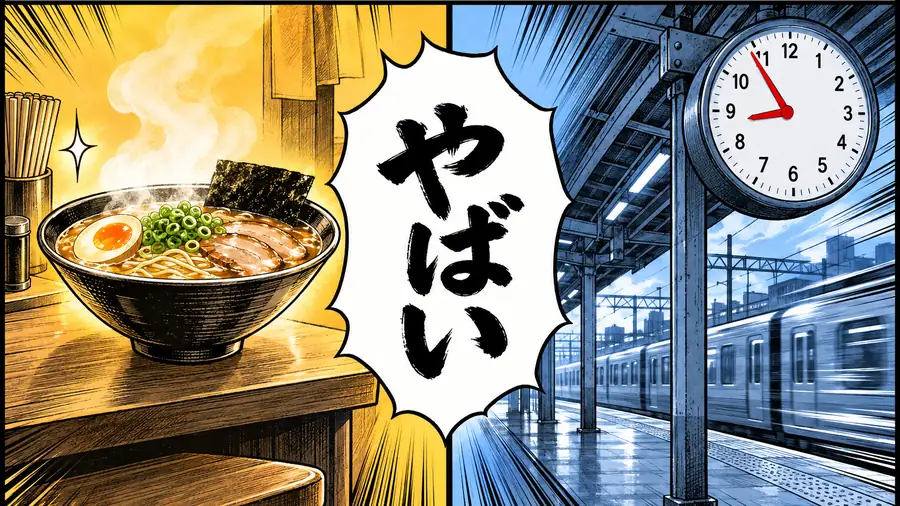
やばい (yabai) is Japanese slang for a strong feeling. It can mean “amazing” or “oh no,” and the situation tells you which. “Oh no, I’ll be late” is やばい、遅刻する (yabai, chikoku suru). “This ramen is insanely good” is このラーメン、やばい (kono rāmen, yabai). It is not a swear word. Say it to friends, and leave it out with your boss.
What you heard, and what it means
Six forms you will hear. Tap one to jump to examples with audio.
- やばい、+ a problem“Oh no”
- この〜、やばい“This is amazing”
- やば・やばっ“Whoa!” A quick reaction
- やばくない?“Amazing, right?” They want you to agree
- やばいね“Wild, huh.” Sharing the feeling
- やべえThe rough version. Better not to copy
Good or bad? How to tell
The word itself only says “this is a lot.” You find the direction in three places. Check them in this order.
| Clue | Good | Bad |
|---|---|---|
| 1. What happened | They tasted, saw, or heard something. They keep going. | Something broke, ran late, or went missing. They stop. |
| 2. Next words | うまい, かわいい, すごい | まずい, 間違えた, a time, a lost thing |
| 3. Face and voice | Smile, bright voice, a long やばーい | Frown, low voice, a short やばい… |
Clue 1 is the strongest. Someone tastes your food and reaches for more. That is praise.
えe、やばいyabai。もうmō一口hitokuchiちょうだいchōdai。
Whoa, that’s amazing. Give me one more bite.
やばいyabai、もうmō八時hachiji五十五分gojūgofunだda。
Oh no, it’s already 8:55.
Clue 2 settles most cases. Listen for the word that comes right after.
やばいyabai、かわいいkawaii。
Oh my gosh, so cute.
One more example
やばいyabai、間違えたmachigaeta。
Oh no, I got it wrong.
Clue 3 comes last for a reason. People also say やばい while teasing or laughing nervously, so the voice can fool you. Use it to confirm what clues 1 and 2 told you.
About people, the word goes both ways. あの人、やばい can mean the person is brilliant, or that you should keep away. Here the clues matter even more.
あのano人hito、やばいyabai。
That person is something else.
Test your ear. Four clips of the same word. Good or bad?
All the meanings, with an English word for each
Dictionaries list many English words for やばい. They fall on two sides. You do not need to learn each one. Read the row, then hear an example.
| Side | Meaning | English words |
|---|---|---|
| Bad | Dangerous | risky, unsafe |
| Bad | In trouble | oh no, crap, we’re done for |
| Bad | In bad shape | awful, terrible, a mess |
| Bad | Suspicious | shady, sketchy, weird |
| Bad | Feeling unwell | sick, about to throw up |
| Good | Amazing | insane, awesome, unreal, wow |
| Good | Cool or cute | sick, fire, so cute |
| Good | Moving | it got me, I cried |
| Either | Extreme | crazy, ridiculously, way too |
Hear one example for each meaning
そのsono道michi、夜yoruはwaやばいyabaiよyo。
That street is risky at night.
やばいyabai、財布saifuがgaないnai。
Oh no, my wallet is gone.
寝不足nebusokuでde顔kaoがgaやばいyabai。
I didn’t sleep, and my face looks awful.
あのanoサイトsaito、やばいyabaiからkara開かないhirakanaiでde。
That site is shady. Don’t open it.
やばいyabai、ちょっとchotto気持ちkimochi悪いwarui。
Ugh, I feel a bit sick.
昨日kinōのnoライブraibu、やばかったyabakatta。
Last night’s show was insane.
そのsono髪型kamigata、やばいyabai。かっこいいkakkoii。
That haircut is sick. So cool.
このkono映画eiga、最後saigoがgaやばいyabai。泣いたnaita。
The ending of this movie got me. I cried.
今日kyō、やばいyabaiくらいkurai暑いatsui。
It’s crazy hot today.
このkonoままmamaだdaとtoやばいyabai。
If this keeps up, we’re in trouble.
Who can say it, and to whom
やばい is casual slang. It is not rude in itself, and it is not a swear word. The question is who you say it to.
| To | OK? |
|---|---|
| Friends, classmates, siblings | Yes |
| Coworkers your age, in a relaxed office | If they say it too |
| Your boss, a teacher, a customer | No |
| A job interview, an email, a speech | No |
| A friend’s parents or grandparents | Better not |
Age changes how it lands. People in their 20s and younger use both the good and the bad sense. People in their 30s and 40s use it too, a little more for bad news. Some people over 60 still hear only “dangerous,” and the praise can sound sloppy to them.
One parent on Reddit wrote that their 3-year-old says やばい, and the grandmother teases him for bad manners. Their line: under about 40, it is just normal speech. Women and men both say やばい. Only the rough やべえ sounds like a guy.
What to say to your boss or teacher instead
Swap the word for one of these. They keep the feeling and sound polite.
すごいsugoiですdesuねne。
That’s amazing.
大変taihenですdesuねne。
That sounds really hard.
すみませんsumimasen、ちょっとchottoまずいmazuiことkotoにniなりましたnarimashita。
I’m sorry, we have a bit of a problem.
Good news gets すごいですね. Their bad news gets 大変ですね. Your own trouble gets まずいことになりました.
ColumnWhere yabai comes from, and which stories to doubt
やばい grew out of an older word, やば (yaba), meaning risky or against the law. It shows up in the comic novel 東海道中膝栗毛 (Tōkaidō-chū Hizakurige, 1802 to 1814). The oldest known uses of やば are from the late 1700s. Where やば itself came from is unknown.
A slang dictionary from 1892 lists やばい as criminal slang for being about to get caught. Through the 1900s it stayed an outlaw word. Young people picked it up in the late 1960s, still in the bad sense.
The good sense came from musicians. In a 1973 essay, jazz pianist Yosuke Yamashita noted that band members used やばい to mean incredible. People started talking about the praise sense in general use after 2000.
Some websites tell other stories. One says やば came from 矢場, archery stalls that hid shady business. Another says it came from 厄場, a word for a jail guard. Others say it came from あやぶい or いやあぶない. Treat these as stories. No old writing supports them.
Sources: Hiroaki Iima, “ヤバい” in 考える人 (Shinchosha), 2016. Wiktionary, やばい, which cites the Nihon Kokugo Daijiten for the 1892 dictionary.
Pick your line: who you are talking to, and how you feel
Open the line picker
Choose the person and the feeling. You get one line with audio and a short note.
このkonoラーメンrāmen、やばいyabai。うますぎるumasugiru。
This ramen is insane. It’s so good.
Name the thing first, then やばい. Add why, like うますぎる, so nobody wonders.
やばいyabai、もうmō八時hachiji五十五分gojūgofunだda。
Oh no, it’s already 8:55.
やばい first, then the problem. Said fast, it works like “oh no.”
このkono資料shiryō、やばいyabaiねne。すごくsugokuわかりやすいwakariyasui。
These slides are great. So easy to follow.
やばいね is fine if they talk this way too. The second sentence makes it clear you mean praise.
やばいyabai、会議kaigiのno時間jikan間違えてたmachigaeteta。
Oh no, I had the meeting time wrong.
Fine with a coworker your age. In a meeting, switch to the polite line for your boss.
すごいsugoiですdesuねne。
That’s amazing.
Leave やばい out. すごいですね carries the same “wow” and is polite.
すみませんsumimasen、ちょっとchottoまずいmazuiことkotoにniなりましたnarimashita。
I’m sorry, we have a bit of a problem.
まずい is the polite cousin of やばい for trouble. Say sorry first.
See all six lines in one table
| Situation | Line | Meaning | Level |
|---|---|---|---|
| A friend, something is amazing | このラーメン、やばい。うますぎる。 | This ramen is insane. It’s so good. | casual |
| A friend, something went wrong | やばい、もう八時五十五分だ。 | Oh no, it’s already 8:55. | casual |
| A coworker your age, something is amazing | この資料、やばいね。すごくわかりやすい。 | These slides are great. So easy to follow. | casual |
| A coworker your age, something went wrong | やばい、会議の時間間違えてた。 | Oh no, I had the meeting time wrong. | casual |
| Your boss or teacher, something is amazing | すごいですね。 | That’s amazing. | polite |
| Your boss or teacher, something went wrong | すみません、ちょっとまずいことになりました。 | I’m sorry, we have a bit of a problem. | polite |
Short forms and endings
You will hear やばい cut short or stretched, and with new endings. Here are the forms to know, each with audio.
やば and やばっ: the quick reaction
やばっyaba’、もうmōこんなkonna時間jikan。
Whoa, look at the time.
The last sound is cut off, like a gasp. Anyone can say it. It works for good and bad.
やべえ: the rough one
やべえyabē、傘kasa忘れたwasureta。
Crap, I forgot my umbrella.
Same word, said rough. You hear it a lot in anime, mostly from guys. A learner who says it sounds like they are copying a cartoon. Use やばっ instead.
やばくない? with a rising voice, and やばくないよ said flat
このkono曲kyoku、やばくないyabakunai?
This song is amazing, right?
えe、やばくないyabakunaiよyo。大丈夫daijōbu。
No, it’s not a problem. It’s fine.
This pair trips people up. With a question and a rising voice, やばくない? means “isn’t it amazing?” They want you to agree. Said flat with よ, it means what it says: “it’s not a problem.”
やばいね: sharing the feeling
やばいyabaiねne、このkono景色keshiki。
This view is wild, huh.
ね invites the other person in. Use it when you both see the same thing.
More endings: past, too much, maybe, looks like
やばい is an i-adjective, a describing word that ends in い. It changes its ending like おいしい or 高い.
| Form | Meaning |
|---|---|
| やばい yabai | is intense (now) |
| やばくない yabakunai | is not a problem |
| やばかった yabakatta | was intense |
| やばくなかった yabakunakatta | was not a problem |
| やばくて yabakute | is intense, and… |
| やばすぎる yabasugiru | is way too much |
| やばそう yabasō | looks bad (or looks amazing) |
| やばいかも yabai kamo | might be a problem |
| やばいくらい yabai kurai | crazy, as in “crazy hot” |
昨日kinōのnoテストtesuto、やばかったyabakatta。
Yesterday’s test was rough.
やばすぎるyabasugiru!全部zenbu半額hangakuだってdatte。
This is too much! Everything is half price.
明日ashitaのno締め切りshimekiri、ちょっとchottoやばいyabaiかもkamo。
Tomorrow’s deadline might be a problem.
空sora、やばそうyabasō。傘kasa持ってmotteいこうikō。
The sky looks bad. Let’s take an umbrella.
How to reply when someone says yabai
Pick your reply by what they meant. You do not have to say やばい back.
They are praising you
ありがとうarigatō!うれしいureshii。
Thanks! That makes me happy.
They love something you showed them
でしょdesho?
Right? I told you.
One more example
ねne!やばいyabaiよyoねne。
Right! It’s crazy, isn’t it?
They are in trouble
大丈夫daijōbu?
Are you okay?
One more example
どうしたdō shita?
What happened?
Two short talks
Friendやべえyabē、終電shūden行っちゃったitchatta。Kanaえe、大丈夫daijōbu?タクシーtakushī呼ぶyobu?
FriendCrap, the last train just left.KanaOh no, are you okay? Should I call a taxi?
Friendこのkonoカレーkarē、やばいyabai。Kanaでしょdesho?駅前ekimaeのnoお店omiseなnaんnだda。
FriendThis curry is insane.KanaRight? It’s from the place by the station.
Yabai and its neighbors: sugoi, maji, uso, abunai
These words often show up near やばい. Each one does a different job.
| Word | Its job |
|---|---|
| すごい sugoi | “Amazing,” or “a lot.” Safe to say politely as すごいですね. |
| まじ maji | “Seriously, for real.” It marks a statement as true. It stacks: まじでやばい. |
| うそ uso | “No way!” Surprise at news. It does not call anyone a liar here. |
| 危ない abunai | “Dangerous.” A plain word for real danger, fine with anyone. |
日本語nihongo、すごいsugoiねne。
Your Japanese is amazing.
Hear three more examples
まじmajiでdeやばいyabai。
Seriously, this is insane.
うそuso、受かったukattaのno?やばいyabai!
No way, you passed? That’s amazing!
そのsono橋hashi、危ないabunaiよyo。
That bridge is dangerous.
You may also hear えぐい (egui). Young people use it a lot like やばい, for things that are intense. It sounds harsher. Learn やばい first.
Mistakes learners make
Each pair shows the line learners say and the line that works.
Adding です and saying it to your boss
× やばいyabaiですdesuねne。
○ すごいsugoiですdesuねne。勉強benkyōにniなりますnarimasu。
That’s amazing. I learned a lot.
です does not make slang polite. やばいですね still sounds like slang to a boss.
Copying やべえ from anime
× やべえyabē!
○ やばっyaba’!
Whoa!
やべえ is rough. From a learner, it often sounds odd. やばっ is light and works for everyone.
Answering やばくない? as if it were about danger
× いやiya、危なくないabunakunaiよyo。
○ うんun、やばいyabaiねne!
Yeah, it’s crazy!
The question means “amazing, right?” Agree with うん、やばいね. If you don’t agree, そうかな? (sō ka na?), “you think so?”, is gentle.
Praising an older person’s cooking with やばい
× おばあちゃんobāchan、これkoreやばいyabai!
○ おばあちゃんobāchan、これkoreすごくsugokuおいしいoishii!
Grandma, this is really good!
To older people, the word can still sound like trouble. Say what you mean: it tastes good.
Thinking yabai is always bad
Many learners first meet やばい as “dangerous.” One learner on Reddit said a coworker asked whether it is always negative. That coworker had only heard it in bad moments. When someone smiles at your work and says やばい, take the compliment.
Check yourself
Nine questions. Three of them are audio clips: listen, then decide if it is good or bad. Three questions to start.
1. Your friend tastes your curry and smiles. They say やばい. What do they mean?
2. Listen. Is this yabai good or bad?
Play the clip
3. Your boss shows you a finished project. What do you say?
4. Listen. Is this yabai good or bad?
Play the clip
5. A friend says この曲、やばくない? You agree.
6. A friend looks at your outfit and says やばい. You can’t tell what they mean.
7. Listen. Is this yabai good or bad?
Play the clip
8. An anime character yells やべえ!. What should you say with friends?
9. Your friend’s grandmother cooked dinner for you. What do you say?
Start with two habits. Say やばい! when something suddenly goes wrong with friends. Say この〜、やばい when food or a view knocks you out and everyone is smiling.
Questions learners ask
Is yabai a bad word?
No. It is casual slang, like “insane” or “sick” in English. It is fine with friends. With a boss, a teacher, or a customer, use a polite word instead.
Is it written in hiragana or katakana?
Both. やばい in hiragana is the plain spelling. ヤバい or ヤバイ in katakana looks louder, like writing it in capitals. You will not see it in kanji.
Is yabai an i-adjective?
Yes. It changes like 高い: やばくない (not), やばかった (was), やばくて (and). The endings table has the full list.
What is the difference between yabai and abunai?
危ない (abunai) only means “dangerous,” and you can say it to anyone. やばい can mean dangerous too, but it is slang and can also be praise. For a real warning, like a car coming, say 危ない!.
What does yabai desu ne mean?
“That’s crazy, isn’t it?” in a slightly softer voice. The です adds a little distance. It is still slang, so it does not suit a boss.
Why do anime characters say yabee?
やべえ (yabē) is the rough way to say やばい. The “ai” turns into a long “ee,” as in tough speech. Anime uses it to make a character sound rough or boyish. It means the same thing.
ColumnWhere this page comes from
The example lines were written for this page. The age and manners notes come from learner posts on Reddit. These include the grandmother story and a coworker who thought the word was always negative. We also asked three AI models the same eight learner questions. We kept the points they agreed on and checked them against dictionaries.
Keep going
- How to say no in Japanese: casual words need the right register; so do refusals.
- Japanese te-form: やばい bends like any i-adjective; verbs bend by their own rules.