Japanese long vowels: hold one vowel for two beats, and spell it right in hiragana
A long vowel is the same vowel held for two beats. It is no louder and no higher. おばさん (obasan, aunt) has four beats. おばあさん (obāsan, grandmother) has five. One beat changes the person.
Long vowels at a glance
- Hear itThe same vowel, two beats long
- Say itOne click per kana. Hold one shape.
- Spell itHiragana adds a vowel. Katakana uses ー. Romaji uses ō.
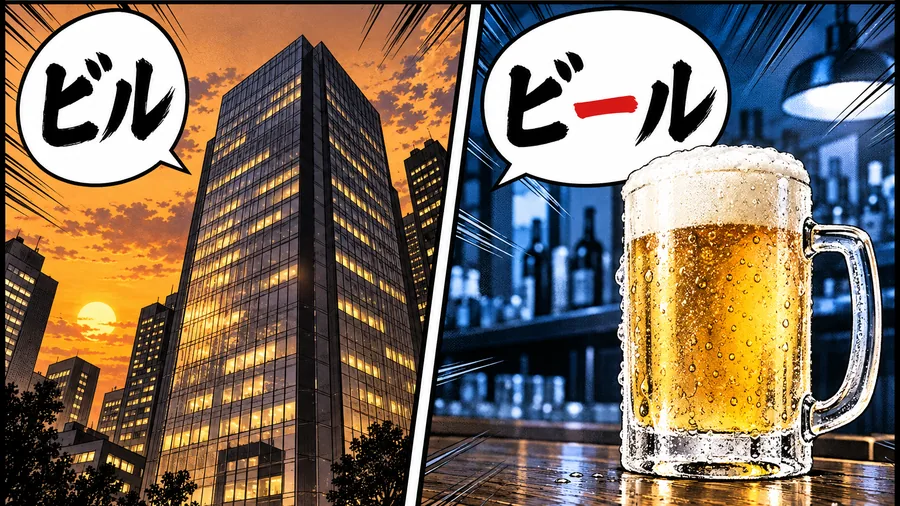
- The dangerous pairsおばさん and おばあさん, ビル and ビール
1. What a long vowel is
Japanese keeps time in beats. Each kana gets one beat, and every beat is about the same length. A long vowel takes two of those beats.
Look at the blocks below. Each block is one beat. The colored block is the second beat of the long vowel.
second beat of a long vowel
おばさんobasan
aunt
おばあさんobāsan
grandmother
A beginner on Reddit asked whether you say the vowel twice, like the “A-Aron” sketch, or hold one sound longer. Hold it. Keep one mouth shape and keep your voice going through both beats. Do not stop and start the vowel again.
Japanese calls this 長音 (chōon), “long sound.” The pronunciation guide covers beats in general. This page stays on long vowels.
2. The dangerous pairs
Length changes meaning. One learner put it simply. A wrong pitch rarely makes a word hard to understand. A wrong length often does. These eight pairs are the classic traps. Play both and count the blocks.
second beat of a long vowel
おばさんobasan
aunt
おばあさんobāsan
grandmother
おじさんojisan
uncle
おじいさんojīsan
grandfather
とりtori
bird
とおりtōri
street
ゆきyuki
snow
ゆうきyūki
courage
Four more pairs
ここkoko
here
こうこうkōkō
high school
病院byōin
hospital
美容院biyōin
hair salon
主人shujin
husband
囚人shūjin
prisoner
ビルbiru
building
ビールbīru
beer
Three more pairs
地図chizu
map
チーズchīzu
cheese
巨大kyodai
huge
兄弟kyōdai
brothers and sisters
角kado
corner
カードkādo
card
Katakana words are traps too. Drop the dash in ビール and you ask for a building.
Test your ear: short or long?
Listen for how long the vowel lasts before the next sound starts. Ignore how loud it is.
Eight clips. Which word do you hear?
3. How to say it
The fix is counting. Set a metronome to about 70 beats a minute. Say one kana on each click. A long vowel gets two clicks.
- Tap a finger on the table for each kana. おばあさん gets five taps.
- On the long vowel, keep your mouth still. Your voice keeps going, so the second tap has no new sound.
- Keep the same volume. Making it louder does not add a beat.
- Keep the same pitch on both beats, unless the word itself changes.
One commenter on Reddit put a number on it. A long vowel is twice as long as a short one, not 1.3 times. Aim for the full second beat.
ありがとうarigatō。
Thank you.
学校gakkō
school
おいしいoishii
tasty
ラーメンrāmen
ramen
One learner said long vowels feel more like singing than speaking. That is a good way to think of it. Each beat is a note, and a long vowel is a note held for two counts.
4. How long vowels are spelled
Hiragana adds a vowel. Which one depends on the vowel the kana ends in. For か, that is a.
| Vowel | Add | Example |
|---|---|---|
| a | あ | おかあさん okāsan, mother |
| i | い | おにいさん onīsan, older brother |
| u | う | くうき kūki, air. すうじ sūji, numbers |
| e | usually い, said ē | えいが eiga, movie. せんせい sensei, teacher |
| o | usually う, said ō | おとうさん otōsan, father. とうきょう tōkyō, Tokyo |
So えい sounds like a long e, and おう sounds like a long o. A learner wrote that こう sounds blended, not like “ko-u.” That is right. It is one o, held.
A few words break the rule. Some long o words use お: おおきい (big), とおり (street), こおり (ice) and とお (ten). A few long e words use え: おねえさん (older sister) and ええ (yes). Learn them as you meet them. Both lists are short. Almost every long e is spelled えい, and almost every long o is spelled おう.
Hear each example
お母さんokāsan
mother
空気kūki
air
数字sūji
numbers
映画eiga
movie
先生sensei
teacher
お父さんotōsan
father
東京tōkyō
Tokyo
大きいōkii
big
とおりtōri
street
Katakana: the dash
Katakana uses one mark for every long vowel, the dash ー. It is a full beat, like any kana. In vertical text it turns into a vertical line.
コーヒーkōhī
coffee
ケーキkēki
cake
ビールbīru
beer
チーズchīzu
cheese
Romaji
Romaji has no single rule. You may see a line on top (ō, ū), a double vowel (oo, uu), or ou. Many signs and names drop the mark, so “Tokyo” hides two long vowels. Count in kana, not in letters. Family names hide them too. Sato, Ito and Kato are さとう, いとう and かとう, each with a long o. (さとう is also “sugar.”)
5. At full speed, and the fake long vowel
Fast speech squeezes many things, but not length. Japanese speakers keep the long vowel at any speed. コーヒー never turns into コヒー.
One sound does drop, and it is a different thing. The u in です (desu) often goes quiet. You hear “des.” That is a whispered short vowel, not a shortened long one. The pronunciation guide covers it.
東京tōkyōにni住んでsundeいますimasu。
Natural speed. Tokyo still has four beats.
I live in Tokyo.
The opposite mistake is a fake long vowel. People stretch a sound for feeling, and that adds a beat that is not in the word. くださーい sounds like a child asking again. Stretch おばさん and it becomes おばあさん.
A stretched ください sounds whiny
× コーヒーkōhī、くださーいkudasāi。
○ コーヒーkōhī、くださいkudasai。
Coffee, please.
6. Common mistakes
Each pair shows the habit and the fix. The audio plays the fix.
Saying obasan when you mean grandma
× おばさんobasanにni電話denwaしたshita。
○ おばあさんobāsanにni電話denwaしたshita。
I called my grandmother.
With four beats, you called your aunt. Hold the あ for the fifth beat.
Saying “Tokyo” as two English syllables
× トキョtokyo
○ 東京tōkyō
Tokyo
とうきょう has four beats: と う きょ う. Both o sounds are long.
Dropping the dash in katakana words
× コヒーkohī
○ コーヒーkōhī
coffee
Each ー is a full beat. コーヒー has four.
Restarting the vowel: “o, okii”
× お・おきいo-okii
○ 大きいōkii
big
Two お in a row make one long sound. Don’t break it in the middle.
Stretching the final う in ます and です
× 住んでいまーすsundeimāsu。
○ 東京tōkyōにni住んでsundeいますimasu。
I live in Tokyo.
The う in です and ます is one short beat, and often whispered. Stretch a vowel only where the kana spell a long one.
Check yourself
Nine questions. Three are audio clips: listen, then pick. Three questions to start.
1. Listen. Who is the speaker asking about?
Play the clip
2. How many beats are in おばあさん (obāsan)?
3. Which is the right way to make a long vowel?
4. Listen. Which word comes first?
Play the clip
5. How do you spell “father” in hiragana?
6. Which word writes its long o with お, not う?
7. Listen. Who is she talking about?
Play the clip
8. You stretch ください into くださーい. How does it sound?
9. How do you write a long vowel in katakana?
Questions learners ask
What is the long vowel mark ー called?
It is 長音符 (chōonpu), the long sound mark. Most people just call it 伸ばし棒 (nobashibō), the stretch bar. In loanwords it can also stand where English had an r: カード (kādo, card), スーパー (sūpā, supermarket). One learner on Reddit said that is the hard part of reading katakana.
How do you write a long o in hiragana, おう or おお?
Usually おう, as in おとうさん and とうきょう. A short list of words uses おお, like おおきい and とおり. Both sound the same.
Why is えい pronounced ē?
In everyday speech, えい blends into one long e. In slow or careful speech, some people say e and i. Either way it takes two beats.
Is there a long vowel in Tokyo?
There are two. とうきょう (Tōkyō) has four beats. The English spelling drops the marks.
How do I type ー?
With a romaji keyboard in Japanese mode, press the minus key (-). On a phone kana keyboard, it is on the わ key.
Do long vowels matter if my pitch is wrong?
Yes, and usually more. A wrong pitch rarely changes the word. A wrong length often does. Get the beats right first, then work on pitch.
ColumnWhere this page comes from
The example words were chosen for this page. The learner stories come from Reddit posts in r/LearnJapanese and r/languagelearning, linked where they appear. We also asked three AI models how to make and hear long vowels, and kept the points they agreed on.
The idea of beats follows the pronunciation module of the Tokyo University of Foreign Studies. See its page on long vowels. For beats in general, see our pronunciation guide.
Keep going
- Japanese pronunciation: long vowels are one of five habits. The others are っ, vowels, the r and です.
- The small っ (small tsu): the other beat English ears miss is a silent one, like きって.
- How to say no in Japanese: いいえ (iie, no) starts with a long い. Three beats.