Japanese pronunciation for English speakers: the 5 habits that give you away
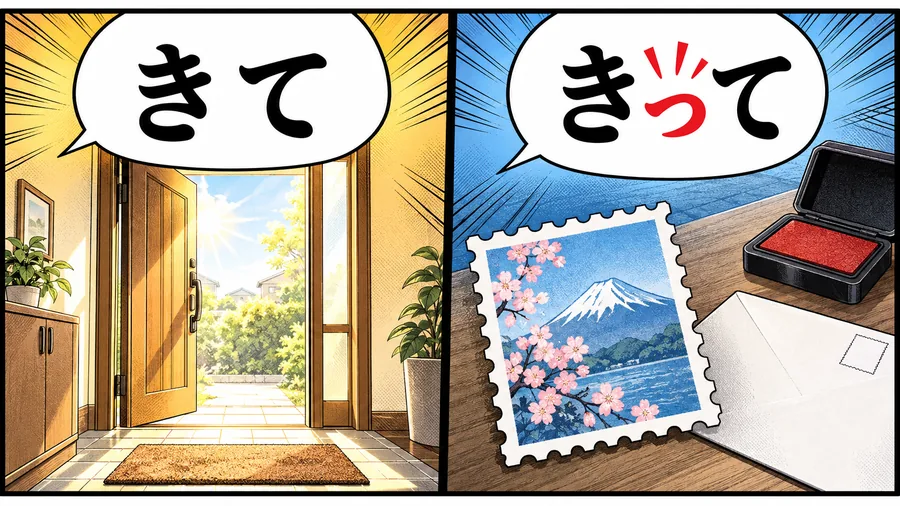
Japanese has five vowels and about 100 syllables, and almost none are new to you. What gives you away is a set of English habits. You slide vowels, rush long vowels, skip the small っ, curl the r, and stress one syllable. きて (kite, “come”) and きって (kitte, “stamp”) differ by one silent beat.
The habits to drop, at a glance
Five habits, plus the full “desu.” Tap one to jump to its section.
- One loud syllableEvery beat the same length
- Long vowels said shortA long vowel gets two beats
- Skipping the small っA silent beat you hold
- Vowels that slide (ay, oh)Vowels that stay still
- The English rOne quick tap of the tongue
- “Desu” with a full “oo”Whisper the す: “des”
1. Count the beats: even timing and long vowels
Japanese keeps time in beats, called mora. One kana is one beat, and every beat takes about the same time.
English works another way. It makes one syllable loud and long, and squeezes the rest. Japanese ears notice that habit first. Say ありがとう (arigatō) as five even beats, and do not stress the り.
ありがとうarigatō。
Thank you.
Small ゃ ゅ ょ join the kana before them, so きょ is one beat. The small っ and ん each take a full beat.
Romaji hides the beats. “Tokyo” looks like two syllables, but とうきょう (Tōkyō) has four beats. Count in kana, not in letters.
A long vowel is two beats
A long vowel is the same vowel held for two beats. It is no louder and no higher. It is only longer.
おばさん (obasan) is “aunt,” with four beats. おばあさん (obāsan) is “grandmother,” with five. Drop the extra beat and you change the person.
silent beat (っ)second beat of a long vowel
おばさんobasan
aunt
おばあさんobāsan
grandmother
One learner on Reddit asked if you say the vowel twice, like repeating a name. You don’t. Keep one mouth shape and hold it through both beats.
Four more pairs that change meaning
Play both and count.
とりtori
bird
とおりtōri
street
ゆきyuki
snow
ゆうきyūki
courage
ここkoko
here
こうこうkōkō
high school
病院byōin
hospital
美容院biyōin
hair salon
How long vowels are spelled
| Sound | How it is written | Example |
|---|---|---|
| long a | add あ | おかあさん okāsan, mother |
| long i | add い | おにいさん onīsan, older brother |
| long u | add う | くうき kūki, air |
| long e | usually add い, said ē | せんせい sensei, teacher |
| long o | usually add う, sometimes お | おとうさん otōsan, father. おおきい ōkii, big |
| katakana | a dash, ー | ラーメン rāmen, ramen |
In romaji, a long vowel gets a line on top (ō) or is written twice (oo).
Test your ear. Four clips. Which word do you hear?
2. The small っ: a silent beat
The small っ has no sound of its own. You get ready for the next consonant, hold it for one beat, then let go.
English already does this between words. Say “bookcase” or “hot tea,” and feel the pause on the k or the t. Japanese does it inside one word and counts the pause as a beat.
A teacher in Japan wrote that few foreigners say these three words right. They test the small っ and the long vowel at once.
silent beat (っ)second beat of a long vowel
来てkite
come
切手kitte
stamp
聞いてkiite
listen
How to hear it
Listen for the gap before て. The t itself is no louder. Before s or sh, you hold the hiss for one beat.
一緒isshoにni行こうikō。
Let’s go together.
Four more pairs with and without っ
Play both and listen for the gap.
いてite
stay
行ってitte
go
音oto
sound
夫otto
husband
坂saka
slope
作家sakka
writer
過去kako
the past
かっこkakko
brackets ( )
Test your ear. Four clips. Is there a silent beat?
A small っ at the end of a word, as in あっ!, is in the questions below.
Count the beats: pick a word
Open the beat counter
Pick one of 24 words. You see one block per beat and can hear Kana say it.
silent beat (っ)second beat of a long vowel
来てkite
come
Two beats, no gap.
切手kitte
stamp
The っ is a held t. Three beats.
おばさんobasan
aunt
Four even beats.
おばあさんobāsan
grandmother
The あ after ば is a second beat. Five beats.
とりtori
bird
Two beats.
とおりtōri
street
お is held for two beats. Three in all.
ゆきyuki
snow
Two beats.
ゆうきyūki
courage
ゆう is two beats. Three in all.
病院byōin
hospital
びょ is one beat. Small ょ joins the kana before it.
美容院biyōin
hair salon
び and よ are two beats here. Five in all.
ちょっとchotto
a little
ちょ is one beat, then a silent beat, then と.
ありがとうarigatō。
Thank you.
Five even beats. Do not stress the り.
こんにちはkonnichiwa
hello
ん is a full beat. Five in all.
ラーメンrāmen
ramen
The dash in katakana is a second beat.
学校gakkō
school
A silent beat, then a long お.
雑誌zasshi
magazine
Hold the sh hiss for the silent beat.
東京tōkyō
Tokyo
Two long vowels. Four beats, though the romaji looks short.
コーヒーkōhī
coffee
Two dashes, two second beats.
先生sensei
teacher
えい is said like a long e: sensē.
切符kippu
ticket
Close your lips for p and hold one beat.
すみませんsumimasen
excuse me
Five beats. ん counts as one.
おいしいoishii
tasty
The last い is held for a second beat.
日本nippon
Japan
A silent beat before ぽ, and ん at the end.
待ってmatte
wait
The small っ in 待って, as in ちょっと待ってください.
See all 24 words in one table
| Word | Romaji | Meaning | Beats |
|---|---|---|---|
| 来て | kite | come | 2 |
| 切手 | kitte | stamp | 3 |
| おばさん | obasan | aunt | 4 |
| おばあさん | obāsan | grandmother | 5 |
| とり | tori | bird | 2 |
| とおり | tōri | street | 3 |
| ゆき | yuki | snow | 2 |
| ゆうき | yūki | courage | 3 |
| 病院 | byōin | hospital | 4 |
| 美容院 | biyōin | hair salon | 5 |
| ちょっと | chotto | a little | 3 |
| ありがとう | arigatō | Thank you | 5 |
| こんにちは | konnichiwa | hello | 5 |
| ラーメン | rāmen | ramen | 4 |
| 学校 | gakkō | school | 4 |
| 雑誌 | zasshi | magazine | 3 |
| 東京 | tōkyō | Tokyo | 4 |
| コーヒー | kōhī | coffee | 4 |
| 先生 | sensei | teacher | 4 |
| 切符 | kippu | ticket | 3 |
| すみません | sumimasen | excuse me | 5 |
| おいしい | oishii | tasty | 4 |
| 日本 | nippon | Japan | 4 |
| 待って | matte | wait | 3 |
3. Five vowels that don’t move
English vowels slide. “Say” ends in a y, and “go” ends in a w. Japanese vowels hold one shape from start to end.
| Vowel | Hold this | Drop this |
|---|---|---|
| あ a | “ah” in “father,” mouth open | “uh” in “about” |
| い i | “ee” in “see,” short | a slide into y |
| う u | “oo” with flat, relaxed lips | round lips, as in “food” |
| え e | “eh” in “bed,” held still | “ay” in “day” |
| お o | “o” in “or,” held still | “oh” sliding into w, as in “go” |
あaいiうuえeおo
the five vowels
When two vowels meet, say both. あお (ao, blue) is a then o. いえ (ie, house) is i then e, and never “yeh.”
青ao
two vowels: a, o
blue
家ie
two vowels: i, e
house
English also turns weak vowels into “uh.” Japanese keeps every vowel full. Every a in さかな (sakana, fish) is the same a.
A Japanese speaker told one learner that their あ sometimes slipped into an “uh” sound. Another learner noticed their vowels held when slow and slipped when fast. Slow down until they hold.
For う, smile a little. Your lips stay flat, so it does not turn into the “oo” in “food.”
Hear three more words
そうsō
right, so
魚sakana
fish
海umi
the sea
4. The r: a single tap
Say “ladder” fast, the American way. Feel the dd. Your tongue tip hits the ridge behind your top teeth once, then drops. That tap is the Japanese r.
The tt in “butter” and “city” is the same tap. Start from “ladder” and keep only the dd.
Two things to avoid. Do not curl your tongue back, as in the English r. Do not press and hold it, as in an l. It touches for an instant.
That is why it can sound like an l or a d. At the start of a word it leans toward l. In the middle it leans toward d. It is the same tap each time.
らraりriるruれreろro
ra, ri, ru, re, ro
それsore
that
りんごringo
apple
り is the hardest, because your tongue is already high for い. Try it slowly first.
The same teacher in Japan hears many people at N2 or N1 with a hard English r. They are understood, and they still sound foreign right away.
Hear two more words
ラーメンrāmen
ramen
車kuruma
car
5. Why です sounds like “des”
い and う often lose their voice. Your throat stops buzzing, so the vowel becomes a whisper. This is called devoicing.
It happens between two voiceless sounds, the sounds you make without a buzz, like k, s, t, h and p. It also happens at the end of a word, after one of those.
So です (desu) sounds like “des,” and 好き (suki) sounds like “ski.” The beat stays, and the vowel is whispered.
学生gakuseiですdesu。
I’m a student.
明日ashita行きますikimasu。
I’ll go tomorrow.
猫nekoがga好きsuki。
I like cats.
One more example
宿題shukudai、したshita?
Did you do your homework?
The voice comes back when people speak slowly or stress a word. In Kansai, around Osaka, people keep more of it. So copy what you hear, and leave most い and う alone.
好きsuki
like (said slowly)
6. Pitch: how much you need
Japanese words have a melody of high and low notes. This is called pitch accent. It changes how high your voice goes, and loudness stays the same.
One learner’s host mother corrected their カキ at a fish market. They could not hear any difference. English ears hear pitch as loudness, so the two words sound the same at first.
To be understood, you need little of it. Context does most of the work, and length and っ change words far more often. To sound natural, pitch matters more.
牡蠣kaki
high then low
oyster
柿kaki
low then high
persimmon
雨ame
high then low
rain
飴ame
low then high
candy
Hum each pair with your mouth closed. Humming hides the consonants, so you hear only the melody.
Two things worth doing now
- Stop stressing. Even beats remove most of the English sound.
- Copy the melody of words you say every day, like ありがとう and すみません. When someone corrects you, ask them to say both versions, and hum along.
ColumnThe pitch accent argument
The top pitch post in r/LearnJapanese drew over 1,500 upvotes. It asked who, apart from people selling courses, calls pitch vital. Its point: once you speak easily, people see a foreigner who speaks well either way.
In the same thread, one learner said a Japanese friend flagged their pitch, yet they were understood. Another studied Japanese at university and nobody mentioned pitch in 20 years.
The other side has a point. One learner scored 100% on pitch drills with single words, yet heard nothing in real talk. Pitch also changes by region, so a host family from Osaka may not match Tokyo.
Our take: start with beats and length. Add pitch through whole phrases once speaking feels easy.
Ready for the basics? Fumi of Speak Japanese Naturally explains the two rules and four patterns in eleven minutes.

Video by Speak Japanese Naturally on YouTube.
Three more sounds: ふ, つ, ん
Not habits, just three sounds English spells differently. Each one is short.
ふ (fu) is blown through both lips, as if you were blowing out a candle. Keep your top teeth off your lip, or it turns into an English f.
船fune
ship
つ (tsu) is t and s in one quick move. Think of the ts in “cats”. Keep the t at the start, or it slides to “su”.
津波tsunami
tsunami
ん (n) is a full beat on its own. One learner described こんにちは this way: stop after こ, wait the length of ん, then say にちは. That makes five beats.
こんにちはkonnichiwa
hello
ん also changes shape with the sound after it, becoming m before b or p. One learner counted seven versions. That needs its own page.
Mistakes learners make
Each pair shows the habit and the fix. The audio plays the fix.
Stressing one syllable
× ありーがとうarīgatōございますgozaimasu。
○ ありがとうarigatōございますgozaimasu。
Thank you very much.
A stretched り sounds like English stress. Keep every beat the same length.
Sliding the お in そう
× そうsowですdesuねne。
○ そうsōですdesuねne。
That’s right.
そう is one steady o held for two beats. Do not let it end in a w.
Dropping the small っ
× ちょとchotoまてmateくださいkudasai。
○ ちょっとchotto待ってmatteくださいkudasai。
Just a moment, please.
Without the silent beats, ちょっと and 待って lose their shape. Hold each っ for one beat.
Reading っ as “tsu”
× きつてkitsuteをo買いたいkaitaiですdesu。
○ 切手kitteをo買いたいkaitaiですdesu。
I’d like to buy stamps.
The small っ is never read as “tsu.” Here it is a held t before て.
Saying every vowel in です
× 日本nihonはwa初めてhajimeteですde-soo。
○ 日本nihonはwa初めてhajimeteですdesu。
It’s my first time in Japan.
Whisper the す. A strong “oo” at the end sounds like a textbook.
An English r in ラーメン
× ラーメンrrah-men、くださいkudasai。
○ ラーメンrāmen、くださいkudasai。
Ramen, please.
Start ラ with a light tap, like the dd in “ladder.”
Calling your grandma your aunt
× うちuchiのnoおばちゃんobachan、九十歳kyūjussaiなnaんnですdesu。
○ うちuchiのnoおばあちゃんobāchan、九十歳kyūjussaiなnaんnですdesu。
My grandma is 90.
One missing beat turns grandma (おばあちゃん) into an aunt or a middle-aged woman (おばちゃん).
Check yourself
Nine questions. Three are audio clips: listen, then pick the word. Three questions to start.
1. Listen. Which word do you hear?
Play the clip
2. How many beats are in ちょっと (chotto)?
3. A learner says ありがとう with a loud, long り. Which habit is that?
4. Listen. Which word do you hear?
Play the clip
5. How many beats are in がっこう (gakkō, school)?
6. You say です with a clear “oo” at the end. What does a Tokyo speaker do?
7. Listen. Which word do you hear?
Play the clip
8. How many beats are in とうきょう (tōkyō)?
9. Your ら sounds like the English “rah,” with your tongue curled back. What should you do?
Check yourself without a teacher
Many learners ask the same thing: if I only copy, how do I know I got it right? Here is what works.
Fix things in this order
Start with what changes words. One beat turns “aunt” into “grandmother,” so length and the small っ come first.
- Long vowels and the small っ
- Still vowels and even beats
- The r tap
- The whispered す in です and ます
- Pitch, through phrases you use every day
One poster on Reddit put it in one line: keep the beats, and give っ and ん a full beat each.
Record, shadow, compare
Pick a short clip, like an example on this page. Listen, record yourself, then play the two back to back. One learner ends every session with this A/B check. Listen again the next day. Right after you speak, your ear is too kind.
Shadowing means speaking along with a recording, half a second behind. After months of shadowing audiobooks, one learner was told they sounded like the news. Another did an hour a day for three months and heard no change. The difference is checking against a recording, a person, or an app.
Compare one feature per pass: first length and っ, then vowel shape, then the r, then the melody. The beat counter and the two ear tests above cover the first pass.
Be careful with speech-to-text
Typing by voice is a weak test. It guesses the word you meant and fixes it for you. One learner saw a video where a Japanese speaker said a word wrong on purpose. The app still marked it right. Pick a checker that tells you which beat slipped.
Questions learners ask
Is Japanese pronunciation hard for English speakers?
Being understood is not hard. Most Japanese sounds already exist in English. Sounding natural takes practice with beats, length and vowels.
Is the Japanese r an l or a d?
Neither. It is a tap: your tongue touches the ridge behind your top teeth once. It can sound like an l at the start of a word, and like a d in the middle. See the r section.
Why do Japanese speakers say l as r?
Japanese has one sound, the tap, where English has two. Both l and r get heard as that one sound. English ears miss the small っ at first for the same reason.
What is the small っ at the end of a word?
It marks a sudden stop, as in あっ! (a!), “oh!” The voice cuts off sharply. You see it in speech and manga to show surprise.
Why is desu pronounced des?
The u in す loses its voice after s at the end of a word. You whisper it, and the beat stays. In slow or careful speech, you may hear the full desu.
Is づ pronounced “du” or “zu”?
“Zu.” Today づ and ず sound the same, and so do ぢ and じ. The spelling “du” is for typing: you type d-u to get づ, as in 気づく (kizuku, “to notice”).
Do I need pitch accent to be understood?
No. Context usually makes the word clear. Pitch helps you sound natural, so add it later through phrases you use every day. See the pitch section.
ColumnWhere this page comes from
The example words and sentences were written for this page. The learner stories come from posts on Reddit’s r/LearnJapanese and r/japanlife, linked where they appear. We also asked three AI models the same eight learner questions and kept the points they agreed on.
The notes on the r and on devoicing follow the pronunciation module of the Tokyo University of Foreign Studies. See its pages on the r sound and devoicing.
Keep going
- Japanese te-form: practice the doubled consonant in 待って and 買って.
- How to say no in Japanese: ちょっと is all about timing, and so is its small っ.
- What yabai means: a stretched やばーい and a short やばい are a length difference too.