The small っ (small tsu): how to say, hear and type it
The small っ is a silent beat. You get ready for the next consonant and hold it one beat. きて (kite) is “come.” きって (kitte) is “stamp.” It is written small and has no sound of its own. Still, it counts as a full beat.
What you will learn
- Say itHold the next consonant
- Hear itListen for a short gap
- Write itっ in hiragana, ッ in katakana
- Type itkitte gives きって
- At the end of a wordA sharp stop: あっ!
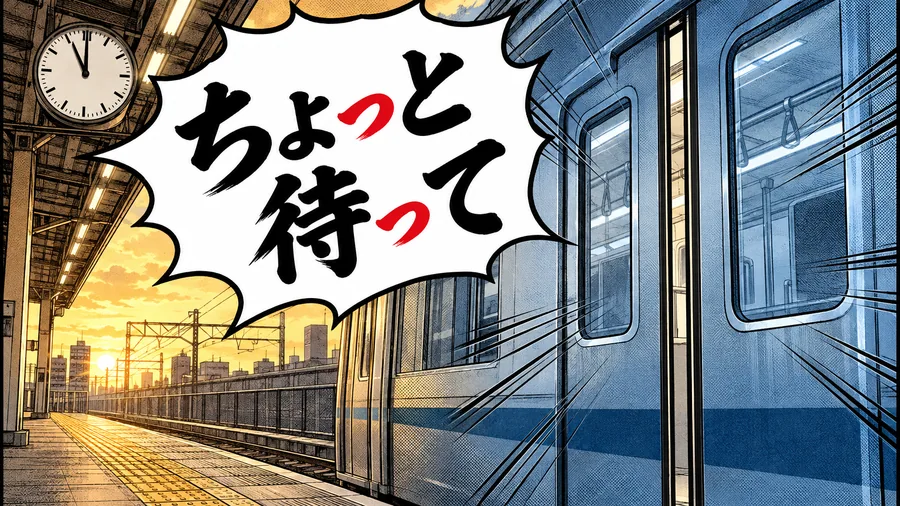
1. What the small っ is
Japanese keeps time in beats. Each kana gets one beat, and the beats are about the same length. Small ゃ ゅ ょ are the exception: they join the kana before them.
The small っ gets a beat too. You just make no sound in it. Think of it as a rest in music: silent, yet it still fills a beat.
silent beat (っ)second beat of a long vowel
来てkite
切手kitte
It looks like つ (tsu) made small, but it never sounds like tsu. In Japanese it is called 促音 (sokuon). Most learners just say “small tsu.”
It matters more than it looks. Learners who live in Japan say long vowels and the small っ matter far more than pitch.
2. How to say it
You make no sound for the っ itself. Instead, you start the next consonant early and hold it.
Put your mouth in place for that consonant. Keep it still for one beat. Then let go into the next kana.
| Next | What you hold | Example |
|---|---|---|
| t, ch, ts | Tongue tip pressed behind your top teeth | きって kitte |
| k, g | Back of your tongue against the roof of your mouth | さっか sakka |
| p | Both lips closed | いっぱい ippai |
| s, sh | The hiss itself, for one beat | ざっし zasshi |
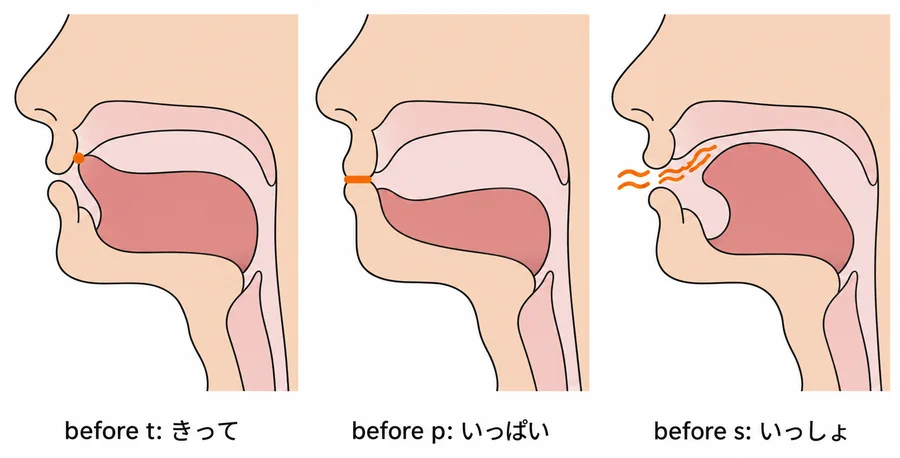
English already does this between two words. Say “bookcase” or “hot tea” at normal speed. Your mouth holds the k or the t before it lets go. Japanese does the same inside one word and counts the hold as a beat.
切手kitte
stamp
作家sakka
writer
いっぱいippai
a lot, full
Before s or sh you cannot stop the air. So the hiss runs for one beat, as in いっしょ (issho, together).
Hear it in a sentence
一緒isshoにni行こうikō。
Let’s go together.
3. How to hear it
Listen for the gap. The consonant after っ is no louder than usual. What you hear is a short silence before it.
The gap lasts about as long as one kana. It gets shorter in fast speech, yet it stays there. Play each pair and listen for it.
来てkite
come
切手kitte
stamp
四日yokka
the 4th (day of the month)
八日yōka
the 8th (day of the month)
This pair is a gap against a long vowel. Both have three beats. よっか holds the k, and ようか holds the o.
Six more pairs with and without っ
待てmate!
Wait! (a blunt order)
待ってmatte
wait (please)
待て (mate) is a blunt order, used with dogs or in anime fights. 待って (matte) is the everyday “wait.”
いてite
stay
行ってitte
go
音oto
sound
夫otto
husband
坂saka
slope
作家sakka
writer
過去kako
the past
かっこkakko
brackets ( )
型kata
shape, type (also 肩, shoulder)
買ったkatta
bought
A commenter in r/japanlife listed three words that few foreigners say right. They test the small っ against a long vowel.
来てkite
come
切ってkitte
cut (and…)
聞いてkiite
listen
切って (cut) and 切手 (stamp) have the same beats. Only the melody differs.
Test your ear. Eight clips. Is there a silent beat? Pick the word you hear.
4. Writing it
In hiragana, the small っ is about half the size of つ. Make the difference clear when you write by hand. Otherwise a reader may see a full つ and say “tsu.”
| Small: silent | Full: tsu | |
|---|---|---|
| Hiragana | きって | きつて |
| Katakana | カット | カツト |
Katakana uses ッ, the small form of ツ. You see it a lot in words from English. A short vowel before a hard final consonant often gets one.
カットkatto
a cut, a haircut
ベッドbeddo
bed
バッグbaggu
bag
Romaji doubles the next consonant. きって is kitte, まって is matte, and がっこう is gakkou or gakkō.
There is one exception. Before ch, you write a t: まっちゃ is matcha. So romaji writes っち as tchi. When you type, both cchi and tchi work.
学校gakkou / gakkō
school
抹茶matcha
matcha (green tea)
One learner only noticed the っ in 抹茶 after years. English says “matcha” with no hold, so the gap is easy to miss.
5. Typing it
On a computer
Turn on the Japanese keyboard and type in romaji. Type the next consonant twice. kitte gives きって, and gakkou gives がっこう.
For っち, type cchi or tchi: maccha and matcha both give まっちゃ. To get a small っ on its own, type xtu, ltu or xtsu.
Katakana works the same way. Type the word, then pick the katakana from the list. On Windows you can press F7. On a Mac, press Control and K.
On a phone
With the kana flick keyboard, type つ first. Flick up on た to get it. Then tap the key to the left of わ, marked 小 with two small dots. つ turns into っ.
On many Android keyboards you can also long-press つ and pick っ from the popup.
The label on the small key differs by keyboard app. On a QWERTY Japanese keyboard, type kitte as on a computer. For katakana, pick the katakana word from the suggestions.
6. At the end of a word
Sometimes っ comes last, with no consonant after it. Then it is a sudden cut-off in the throat, like the break in “uh-oh.” You never read it as “tsu.”
One learner on Reddit made the same “uh-oh” comparison.
あっa!
Oh!
えっe?
Huh? What?
You see it in manga and in text messages. Casual speech also clips adjectives this way. すごい (sugoi, amazing) becomes すごっ!, a quick “whoa!”
やばい (yabai) gets clipped the same way. やばっ! is a quick “whoa!” or “oh no!” See our page on yabai.
すごっsugo!
Whoa! (short for すごい)
やばっyaba!
Whoa! / Oh no! (clipped やばい)
One more example
あっa、雨ameだda。
Oh, it’s raining.
ColumnWhere the っ in kanji words comes from
Many kanji readings end in つ, ち, く or き. When a k, s, t or p sound comes next, that last kana often turns into っ.
学 (gaku) and 校 (kō) make 学校 (gakkō, school). 抹 (matsu) and 茶 (cha) make 抹茶 (matcha). 日 (nichi) and 本 (hon) make 日本 (nippon).
One learner explained it this way on Reddit, with 結構 (kekkō) and 日本 as examples.
7. Mistakes learners make
Each pair shows the slip and the fix. The audio plays the fix.
Dropping the っ
× ちょとchoto高いtakaiですdesu。
○ ちょっとchotto高いtakaiですdesu。
It’s a bit expensive.
Reading っ as “tsu”
× きつてkitsuteをoはつてhatsuteくださいkudasai。
○ 切手kitteをo貼ってhatteくださいkudasai。
Please put a stamp on it.
The small っ is never “tsu.” Here it is a held t, twice.
A loud t in place of a gap
× いてi-TEきますkimasu。
○ 行ってitteきますkimasu。
I’m off. (said when you leave home)
A strong t with no gap sounds like いて, “stay.” Keep the t soft and hold the silence before it.
Skipping っ at full speed
× もとmotoゆくりyukuriいてiteくださいkudasai。
○ もっとmottoゆっくりyukkuri言ってitteくださいkudasai。
Please say it more slowly.
Fast speech squeezes the three gaps, and they still count. Say it slowly first, then speed up.
Three more slips: a big つ, a long vowel, and a gap before sh
Reading a small っ as a big つ
× かつてkatsute
○ 買ってkatte
buy, and… (te-form of 買う)
かつて (katsute) is a real word: “once, long ago.” 買って (katte) has a small っ and means “buy, and…”. Look at the size of the kana before you read it.
Stretching the vowel
× きーてkiite
○ 切手kitte
stamp
Keep the vowel short: kitte, not kiite. The beat goes to the held t, not to the き.
A silent gap before sh
× い…しょにi…shoni行こうikō。
○ 一緒isshoにni行こうikō。
Let’s go together.
Before s or sh, keep the hiss going for the beat. Do not go silent.
Check yourself
Nine questions. Three are audio clips: listen, then pick. Three questions to start.
1. Listen. Which word do you hear?
Play the clip
2. How many beats are in きって (kitte)?
3. You want きって on a computer. What do you type?
4. Listen. Which day is it?
Play the clip
5. How do you say the っ in あっ!?
6. How is まっちゃ written in romaji?
7. Listen. How many silent beats do you hear?
Play the clip
8. You use the flick keyboard on your phone. How do you get っ?
9. Your きって sounds like きて with a loud t. What should you change?
Questions learners ask
Is the small tsu silent?
Yes. It has no sound of its own, yet it takes one beat. You hold the next consonant during that beat. See how to say it.
What is the small っ called?
小さいつ (chiisai tsu) is the name of the letter. 促音 (sokuon) is the name of the job it does. In English most people say “small tsu” or “double consonant.”
How do I type small tsu on iPhone, Android or a PC?
On a PC, type the next consonant twice, like kitte. For a lone っ, type xtu or ltu. On a phone flick keyboard, type つ and tap the 小 key. See typing it.
What does っ at the end of a word mean?
It marks a sudden stop, as in あっ! (oh!) or えっ? (huh?). Linguists call this sharp stop a glottal stop. It shows surprise in speech, manga and texts. You do not say “tsu.”
Can the small っ come before ん or な? Is ざっねん right?
No. The small っ comes only before k, s, sh, t, ch, ts and p, plus some voiced sounds in loanwords like ベッド. It never comes before n, m, y, w or a vowel. “Too bad” is ざんねん (zannen), with ん. A learner asked this on Reddit.
Is there a small tsu in katakana?
Yes, ッ. It works the same way as っ, as in ベッド (beddo, bed) and バッグ (baggu, bag).
Why is っ written as a double letter in romaji?
The doubled letter shows the held consonant. kitte has a t that lasts a beat longer than in kite. Before ch it is written t, as in matcha.
ColumnWhere this page comes from
The example words and sentences were written for this page. Some recordings are shared with our guide to Japanese pronunciation, which covers the small っ in brief. This page goes deeper.
The learner quotes come from Reddit. One is the 来て 切って 聞いて comment in r/japanlife. Another is the “uh-oh” comparison in r/LearnJapanese. A third poster put the rule in one line: っ and ん each need a full beat.
Want more detail on Japanese sounds? The Tokyo University of Foreign Studies has a free pronunciation module. Start with its page on the r sound.
Keep going
- Japanese pronunciation: the small っ is one of five habits; the guide covers long vowels, the r and pitch too.
- Japanese te-form: 待って, 行って and 切って: many te-forms carry a small っ.
- How to say no in Japanese: ちょっと, the softest no, needs its small っ.